

The Homeschool Fair THING (May 2026)
The Storytelling Thing: Family Follow-Up Guide
After helping the Interdimensional Space-Time Thing Detectives solve the mystery of the… THING!, families can continue the adventure at home with this playful storytelling guide. Together, children and grown-ups can explore what makes a story work, think about characters, conflict, setting, and perspective, and reflect on how different people can experience the same mysterious Thing in totally different ways.
This guide invites families to keep asking questions, imagining possibilities, and telling the story of Thing together.
Storytelling Lesson Plan
A Letter from THING:
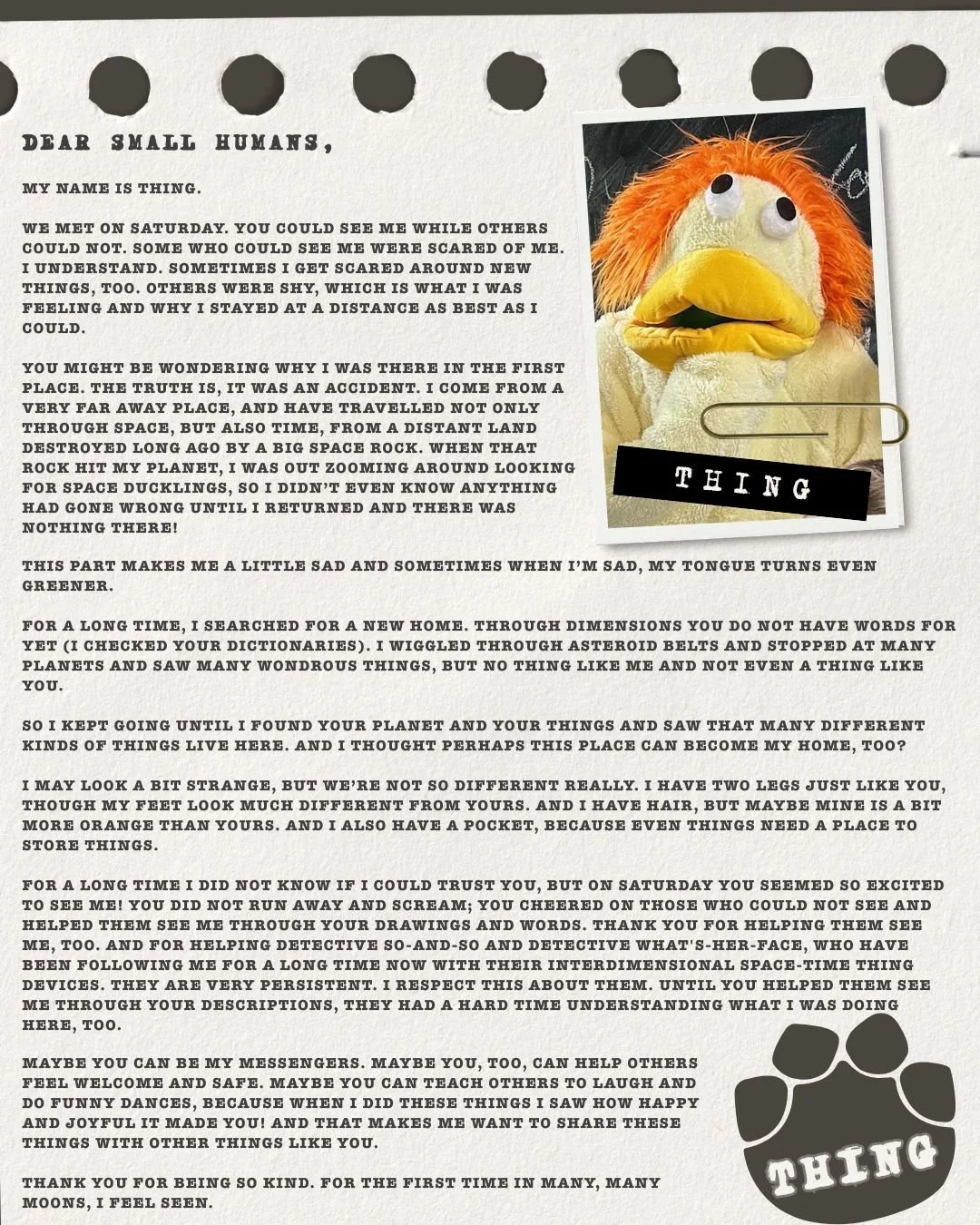
Dear Small Humans,
My name is Thing.
We met on Saturday. You could see me while others could not. Some who could see me were scared of me. I understand. Sometimes I get scared around new things, too. Others were shy, which is what I was feeling and why I stayed at a distance as best as I could.
You might be wondering why I was there in the first place. The truth is, it was an accident. I come from a very far away place, and have traveled not only through space, but also time, from a distant land destroyed long ago by a big space rock. When that rock hit my planet, I was out zooming around looking for space ducklings, so I didn’t even know anything had gone wrong until I returned and there was nothing there!
This part makes me a little sad, and sometimes when I’m sad, my tongue turns even greener.
For a long time, I searched for a new home. Through dimensions you do not have words for yet. I checked your dictionaries. I wiggled through asteroid belts and stopped at many planets and saw many wondrous things, but no thing like me and not even a thing like you.
So I kept going until I found your planet and your things and saw that many different kinds of things live here. And I thought perhaps this place can become my home, too?
I may look a bit strange, but we’re not so different really. I have two legs just like you, though my feet look much different from yours. And I have hair, but maybe mine is a bit more orange than yours. And I also have a pocket, because even Things need a place to store things.
For a long time I did not know if I could trust you, but on Saturday you seemed so excited to see me! You did not run away and scream. You cheered on those who could not see and helped them see me through your drawings and words.
Thank you for helping them see me, too. And for helping Detective So-and-So and Detective What’s-Her-Face, who have been following me for a long time now with their Interdimensional Space-Time Thing Devices. They are very persistent. I respect this about them.
Until you helped them see me through your descriptions, they had a hard time understanding what I was doing here, too.
Maybe you can be my messengers. Maybe you, too, can help others feel welcome and safe. Maybe you can teach others to laugh and do funny dances, because when I did these things I saw how happy and joyful it made you! And that makes me want to share these things with other things like you.
Thank you for being so kind. For the first time in many, many moons, I feel seen.
Thing 🐾
Lesson: The Fundamentals of Storytelling
What is a story? At first, we were going to learn about how to tell a story, but then a thing happened… Thing showed up, and suddenly we were all part of the story!
A story is a sequence of events connected by cause and effect.
Something happens, which causes something else to happen, and so on.
Stories have characters dealing with some kind of problem or challenge, and they take place somewhere: a forest, a school classroom, outer space.
The character in our story was the Thing. Thing was special; only the children could see the Thing (not even the adult Interdimensional Space-Time Thing Detectives could see it without their special gadgets)!
The adults relied on the children's descriptions to understand what was happening. This type of story is a kind of mysteryin which we are asking the question, What is happening? It relies heavily on eyewitness accounts, interpretations, and a communal, accumulated narrative. In other words, we gather as much information as possible (just like space-time Thing detectives!) to solve the mystery of who the Thing is and what it might want.
When it comes to storytelling, most stories share some things in common:
CHARACTERS: Someone (or some Thing) the reader follows. Experiences in the story happen between characters or to characters.
CONFLICT: This is often what keeps a story moving. Conflict can be internal (a character fighting their own fears), between people, between a character and a system, or between a character and something bigger, like nature, fate, or some unknown Thing.
PLOT:This is the order and shape of events. Most stories follow a familiar arc: things are going along as they have been, and then something happens - or maybe a Thing interrupts - tension builds, and then there's a resolution and a new normal begins.
SETTING:More than just backdrop, where and when a story takes place shapes what's possible, what's at stake, and who characters can be. In our case, the story of the Thing took place in a classroom. The classroom became the setting.
Why Do We Tell Stories?
Stories do more than entertain. Humans have been telling stories for longer than we could write them down, and there are good reasons why:
To make sense of things Story is how we explain the world to ourselves and each other. In our case, we want to understand what the Thing is, what it might want, and why only certain people can see it.
To build empathy Stepping into another person's perspective, even a fictional one, trains us to understand people who aren't like us. The Thing isn't from around here, but piecing together its story may have helped us feel something for what it might be doing here.
To pass down knowledge Myths, oral traditions, and history carry values, warnings, and cultural identity across generations.
To entertainIf a story doesn't engage you, it can't do anything else for you either.
To challenge assumptions Stories can make familiar things feel strange in ways a lecture can't.
To ask "what if?" Fiction is a safe place to test fears, ideas, and possibilities without real-world consequences.
And all of that depends on one thing:
Whose perspective are we seeing it from?
Worldview: The Lens Through Which You See the World
Worldview is the story you already have before anything happens. It's the set of assumptions, values, and experiences you carry into every new situation.
When something unexpected occurs, like, say, an interdimensional Thing appearing in your classroom, you don't experience it raw. You experience it through interpretation shaped by your culture, your family, your language, and everything that has ever happened to you.
Think of worldview as a lens you look through, which means you usually can't see the lens itself. You see everything through it, but rarely at it.
That's what made our class exercise so revealing. Every student in the room was looking at the same Thing, and yet no two descriptions were quite identical. One person noticed its movement. Another noticed what it seemed to want. Someone else noticed what it didn't do. None of you were wrong; you were all reporting honestly, but you were each reporting from inside your own worldview.
Every narrator, every witness, every character is standing somewhere, looking at a Thing from a different vantage point.. The question isn't whether your perspective is shaped by who you are; it always is. The question is whether you're aware of it.
A story told from an unexamined worldview might trigger a response that is mismatched from the experience.
For example, a person who has long studied Thing will likely not be fearful of Thing, but someone who has never before seen anything like Thing, might show fear and react accordingly. The Thing hasn’t changed in these two situations; it’s just two different worldviews shaping how the individuals each respond.
Learning to recognize your own lens is helpful.
It allows you to ask:
Why do I see it this way?
What might I be missing?
Whose story isn't being told here?
The best stories, the ones that stay with us, often work precisely because they make the lens visible. They show us that what we thought was just "the way things are" is actually one interpretation among many.
Closing Discussion Questions
What did you notice about the Thing that no one else mentioned? Why do you think you noticed that?
What is your story of the Thing?
Is there such a thing as an unbiased story? Should we even try to tell one, or is it more honest to know your bias and name it?
Once you’ve read Thing’s letter, discuss how your idea of what Thing was doing is different from what Thing shared in the letter? How might your two views of what happened be different and why?